

In short
- Under EU law, jam is made from fruit pulp or purée, jelly from fruit juice or water extracts, and marmalade from citrus fruit.
- Confiture and Konfitüre are the French and German words for jam; extra jam is made from unconcentrated pulp and contains more fruit than jam.
- Ukrainian cooks distinguish varennia (whole fruit in syrup), dzhem (soft-set and spreadable) and povydlo (a thick, smooth fruit butter for baking).
- MADESA plum jam contains only plums (70.9 %), white sugar and citric acid, sterilised without added preservatives in a 1.2 kg glass jar.
- Plum jam suits syrnyky, crêpes, enclosed pastries and breakfast buffets; for open bakes in a hot oven, povydlo holds its shape better.
On this page
- What EU law says: jam, extra jam, jelly and marmalade
- Where confiture fits, and a few false friends
- Varennia, dzhem and povydlo: the Ukrainian vocabulary
- The terms at a glance
- What is in the MADESA plum jam
- How plum jam is used in Ukraine and beyond
- Plum jam in breakfast and food service
- A practical summary for buyers
Jam, jelly and marmalade are three different products under EU law: jam is set fruit pulp or purée, jelly is set fruit juice, and marmalade is made from citrus fruit. Confiture is not a fourth category but the French word for jam, and German uses Konfitüre in exactly the same way. Ukrainian kitchens add a vocabulary of their own, varennia, dzhem and povydlo, which describes texture and use rather than legal status.
What EU law says: jam, extra jam, jelly and marmalade
The reference text is Council Directive 2001/113/EC, which reserves a small set of product names for fruit spreads sold in the EU and defines each of them. In simplified form:
- Jam is a mixture of sugars, the pulp and/or purée of one or more kinds of fruit, and water, brought to a suitable gelled consistency.
- Extra jam follows the same definition but is made from unconcentrated pulp and must contain more fruit than ordinary jam.
- Jelly is a sufficiently gelled mixture of sugars and the juice and/or water extracts of fruit, so it contains no pieces. An extra jelly category exists with a higher fruit requirement.
- Marmalade is a gelled mixture of water, sugars and products of citrus fruit: pulp, purée, juice, water extracts or peel. A jelly marmalade is a marmalade with the insoluble parts removed, apart from finely cut peel.
For each category the directive sets a minimum quantity of fruit used per kilogram of finished product, and the "extra" versions require more. The directive has been amended since 2001, so for exact thresholds read the current consolidated text rather than an older summary. It also prescribes how fruit content appears on the label, in the form "prepared with … g of fruit per 100 g". Each Member State applies these rules through its own national law, in Germany the Konfitürenverordnung, and that national text is what a label is checked against.
Two consequences matter for buyers. First, the product name on an EU label is not a free choice; it follows the definition the recipe actually meets. Second, the fruit statement is calculated from the recipe, so the label owner needs the manufacturer's formulation data before the artwork is drafted.
Where confiture fits, and a few false friends
"Confiture" is the word the French-language version of the directive uses for jam, with "confiture extra" for extra jam. German does the same with Konfitüre and Konfitüre extra. In English, confiture is not a defined category; on a label it signals a style, usually a softer set with visible fruit, but legally the product must still meet one of the defined categories, most often jam or extra jam.
The word "marmalade" causes more confusion than any other in this group:
- In English, marmalade means a citrus product, typically made from oranges.
- In German, Marmelade is the everyday word for any fruit spread, while in the directive's sense it denotes a citrus product. Some Member States tolerate the broader use in local trade, so check the national rules of the target market before you print it.
- In Ukrainian, мармелад (marmelad) is not a spread at all but a confection: firm fruit jellies cut into pieces, often rolled in sugar.
A Ukrainian description that says "marmelad" therefore belongs in the sweets aisle, not next to the jams.
Varennia, dzhem and povydlo: the Ukrainian vocabulary
Ukrainian home cooking distinguishes fruit preserves by how far the fruit is broken down and how firm the result is. Three words do most of the work.
- Varennia (варення) is whole berries or fruit pieces cooked in a clear syrup that does not set. The fruit keeps its shape and the syrup stays liquid. Sour cherry, strawberry and apricot are the classics, and young green walnuts are a speciality. Varennia is eaten by the spoon from a small dish with tea, and it is the most prized jar in a family pantry.
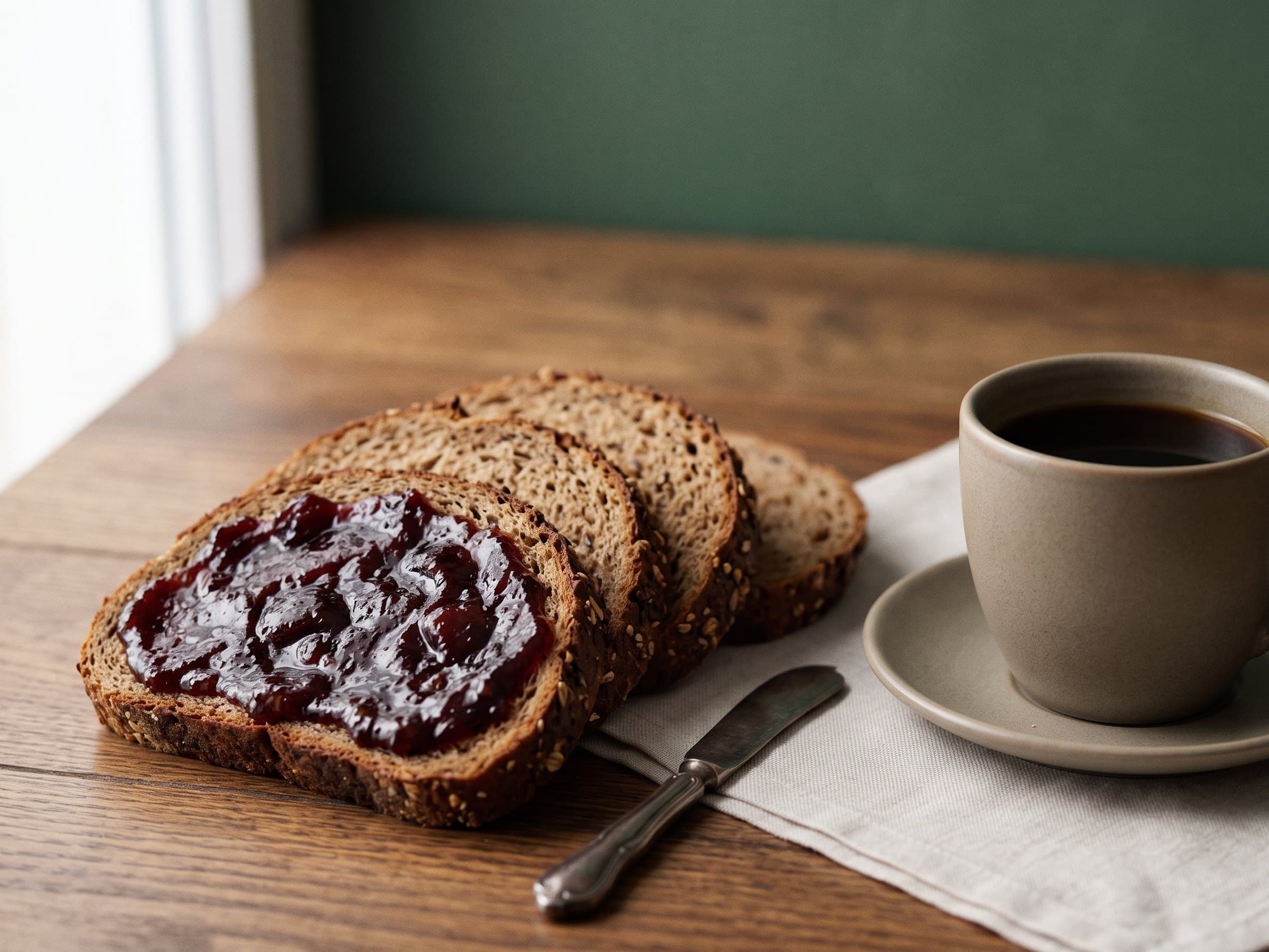
- Dzhem (джем) is fruit cooked with sugar to a soft, spreadable set, with pieces or as a uniform mass. It is the closest equivalent to the EU's jam, and it is what our plum product is.
- Povydlo (повидло) is fruit purée boiled down slowly until thick and smooth, with no pieces at all. Plums and apples are the traditional bases. Povydlo holds its shape inside a pastry, which is why bakers prefer it for fillings.
Two more terms appear on Ukrainian shelves. Konfitiur (конфітюр) usually denotes fruit or berries in a jelly with clearly visible pieces, often set with pectin. Zhele (желе) is a set fruit juice, close to the EU's jelly. Povydlo also has relatives across Central Europe: Czech and Slovak povidla, Austrian Powidl and German Pflaumenmus are all thick plum butters with the same role in baking.
The terms at a glance
| Term | Context | Made from | Texture | Typical use |
|---|---|---|---|---|
| Jam, Konfitüre, confiture | EU legal name | Fruit pulp or purée, sugar | Gelled, may contain pieces | Spreads, breakfast, baking |
| Extra jam | EU legal name | Unconcentrated pulp, more fruit | Gelled, usually more fruit pieces | Premium retail ranges |
| Jelly | EU legal name | Fruit juice or water extracts | Clear, no pieces | Glazes, breakfast, cheese |
| Marmalade | EU legal name | Citrus fruit | Gelled, often with peel | Toast, baking |
| Varennia | Ukrainian | Whole fruit in syrup | Liquid syrup, whole fruit | With tea, desserts |
| Dzhem | Ukrainian | Fruit and sugar | Soft set, spreadable | Syrnyky, crêpes, bread |
| Povydlo | Ukrainian | Slowly reduced fruit purée | Thick, smooth | Pastry fillings |
| Marmelad | Ukrainian | Fruit purée or juice, gelling agent | Firm, cut into pieces | Confectionery |
What is in the MADESA plum jam
Our plum jam, sold under the MIRASA brand, is a dzhem in the Ukrainian sense and a jam in the EU sense. The ingredient list is short:
- plums, declared at 70.9 %;
- white sugar;
- citric acid.
There is no added pectin and no thickener. Plums carry enough natural pectin to set with sugar as they cook down, and the citric acid provides the acidity that pectin needs to gel. The jam is sterilised in a 1.2 kg glass jar, made without added preservatives and graded first grade under the Ukrainian standard DSTU 4900:2007. It keeps for 24 months from the date of manufacture when stored at 0 to +25 °C and a relative humidity of no more than 75 %. Our guide to DSTU and TU labels explains what the standard line and the grade mean.
For an EU label, the 70.9 % plum figure is the starting point for the fruit statement, but the final "prepared with … g of fruit per 100 g" wording is calculated by the label owner from the formulation. We supply the specification data on request.
How plum jam is used in Ukraine and beyond
Plums ripen in Ukrainian gardens at the end of summer, and plum jam has a set of very ordinary uses:
- Syrnyky. Fried curd cheese patties with sour cream and a spoon of jam are probably the most common pairing; our syrnyky with plum jam recipe shows the classic version.
- Crêpes and pancakes. Thin mlyntsi, rolled nalysnyky and small yeast oladky are all served with jam, spread inside or on the side.
- Enclosed pastries. Pyrizhky, crescent-shaped rohalyky and yeast buns take jam as a filling. Because a standard jam softens and can bubble in a hot oven, it works best sealed inside dough; for open tarts and lattice cakes bakers often choose povydlo or thicken the jam with a little starch or ground nuts.
- After the oven. Warmed and sieved, plum jam glazes fruit tarts and holds sponge layers together.
- Savoury plates. Plum goes well with roast pork, duck and aged cheese, and a spoon of jam rounds off a pan sauce.
Plum jam in breakfast and food service
For hotels, cafés and bakeries, a 1.2 kg jar is a working format rather than a retail one. The jam is decanted into portion dishes for a breakfast buffet, dosed onto syrnyky and pancakes at the pass, or used as an ingredient in the pastry section. A few practical points:
- Unopened jars are stored dry at 0 to +25 °C, so no cold room space is needed until service.
- Once opened, keep the jar refrigerated, take product out only with a clean utensil and mark the opening date; a jam without preservatives should be treated as a perishable once the seal is broken.
- The ingredient list contains none of the allergens that EU law requires to be emphasised, which keeps the allergen matrix simple; ask for the full specification if your procedure also covers cross-contact.
- Glass shows the colour and the fruit at a glance, which helps with stock rotation and with display front of house.
Our food-service page sets out how we supply kitchens and caterers.
A practical summary for buyers
- Under EU law, the name follows the recipe: jam, extra jam, jelly or marmalade; confiture and Konfitüre are language variants of jam.
- In Ukrainian, dzhem corresponds to jam, varennia is fruit in syrup, povydlo is a thick fruit butter and marmelad is a confection.
- Our plum jam contains plums (70.9 %), white sugar and citric acid and nothing else, sterilised in a 1.2 kg jar with a shelf life of 24 months.
For prices, logistics or a specification for your own label, request a quote.
Frequently asked questions
Is confiture the same as jam?
In substance, yes. Confiture in French and Konfitüre in German are the legal names for what EU English calls jam, and their extra versions correspond to extra jam. On an English-language label, confiture signals a style rather than a separate category. In Ukrainian shops, konfitiur usually means fruit pieces held in a jelly.
What is the difference between jam and preserves?
Mostly a matter of English usage. In everyday speech, preserves usually means fruit kept in larger pieces or whole, while jam is softer and more uniform; in the United Kingdom, preserves is also an umbrella term for jams and similar products. The EU directive does not define preserves as a separate product. The closest Ukrainian equivalent is varennia, whole fruit in syrup.
Does plum jam need added pectin?
Not necessarily. Plums contain natural pectin, so with sugar and enough acidity they set when cooked down properly. The MADESA plum jam has no added pectin: its ingredients are plums, white sugar and citric acid.
How long does jam keep after opening?
It depends on the sugar content, the temperature and how the jar is handled. Keep an opened jar in the refrigerator, use a clean spoon and follow the guidance on the label. A jam made without preservatives is best used promptly once opened and discarded at any sign of mould or fermentation.
Is povydlo the same as Powidl or Pflaumenmus?
They are close relatives. All three are fruit purées, most often plum, cooked down slowly until thick and smooth. Povydlo is denser and smoother than jam, which is why bakers choose it for fillings that must hold their shape in the oven.