

In short
- Unopened MADESA jarred vegetables keep for two or three years, as printed on the label, when stored at 0 °C to +25 °C and no more than 75 % relative humidity.
- The date on sterilised preserves is a best-before date that guarantees quality; use-by dates are reserved for highly perishable foods such as fresh meat.
- A bulging lid, raised safety button, leak, fizzing or off smell means the jar must be discarded without tasting, whatever the date.
- Once opened, a jar is a chilled food: keep it covered in the fridge, use a clean utensil, keep contents under their liquid and finish within a few days.
- Professional kitchens should label opened containers with the opening time, discard date and batch code, and decant 3 kg jars and 5 kg pails.
On this page
- Best before or use by: what the date on a jar means
- How long MADESA preserves keep unopened
- What “0 °C to +25 °C, humidity up to 75 %” means in practice
- Warning signs: when a jar should not be used
- After opening: the fridge and the clean-spoon rule
- Managing opened jars in a professional kitchen
- A practical summary for buyers
An unopened jar of sterilised vegetables keeps for the period printed on its label, two or three years across the MADESA range, provided it is stored dry at 0 °C to +25 °C and the seal is intact. That date is a best-before date: a promise about quality, not a safety deadline. Once the jar is opened, the promise ends, and the contents become a chilled food to be kept covered in the fridge, taken out with a clean utensil and used within a few days.
Best before or use by: what the date on a jar means
European food labelling distinguishes two kinds of date. Under Regulation (EU) No 1169/2011 on food information to consumers:
- “Best before” marks the date of minimum durability: the date until which a food, stored correctly, keeps its specific properties, such as colour, texture and flavour.
- “Use by” is reserved for foods that are microbiologically highly perishable, such as fresh meat or chilled ready meals. After a use-by date, a food is regarded as unsafe.
Sterilised jarred vegetables belong to the first group. The heat process and the vacuum seal make them stable at ambient temperature, so the date tells you how long the producer guarantees the full quality of the unopened product. On Ukrainian labels the same two ideas read «Найкраще до» and «Вжити до».
Two practical points follow. A best-before date is not a cliff edge: an intact jar does not become unsafe the day after, but its quality is no longer guaranteed, and whether such stock may still be sold is a matter for national rules and retailer policy. And the date holds only while the label’s storage conditions are met; a jar that spent a week in a hot van or a frozen yard has not had the storage the date assumes.
Ukrainian labels often give the date of manufacture together with the shelf-life period, which is why our plum jam, for example, states “24 months from the date of manufacture”.
How long MADESA preserves keep unopened
Every MADESA product carries the same storage instruction, 0 °C to +25 °C at a relative humidity of no more than 75 %, but the shelf life differs by recipe:
| Product | Pack | Shelf life unopened |
|---|---|---|
| Tomato paste, sterilised, premium grade | 500 g jar | 3 years |
| Tomato paste, pasteurised | 5 kg pail | 2 years |
| Sauces “Ketcha”, “Lecho”, “Satsebeli”, “Ukrainian”, “Ukrainian Hot” | 485 g tall jar | 3 years |
| Courgette ikra, sweet pepper ikra, dried tomatoes in oil | 650 g jar | 3 years |
| Pickled tomatoes with herbs, tomato juice with salt | 3 kg jar | 3 years |
| Pickled gherkins, sliced pickled courgettes, marinated button mushrooms | 3 kg jar | 2 years |
| Lecho, vegetable sauté, aubergines in adjika, hot adjika, Mexican fiesta, beans with vegetables | 480 g jar | 2 years |
| Beans in a delicate sauce, beans in tomato sauce | 700 g jar | 2 years |
| “Zakusochnyi” vegetable salad, pitted black and green olives | 1 kg jar | 2 years |
| Plum jam | 1.2 kg jar | 24 months from manufacture |
For a sterilised product, the length of the shelf life is set by how long colour, texture and flavour stay at their best rather than by a microbiological limit; our article on sterilisation explains why. The 5 kg tomato paste is pasteurised rather than sterilised, and its label declares a preservative, ascorbic acid.
What “0 °C to +25 °C, humidity up to 75 %” means in practice
The storage line on the label is short, but each number protects something specific.
- Not below 0 °C. Water expands as it freezes. In a sealed jar that can crack the glass, lift the lid or break the vacuum; even when the jar survives, freezing softens pickles and makes sauces separate. The usual risk is a pallet left in an unheated lorry or yard in winter.
- Not above +25 °C. Within the range a sterilised product is stable. Above it, the slow chemistry that ends its shelf life speeds up: tomato products darken, green vegetables fade, aromas flatten and textures soften. Long exposure to strong heat can also lead to spoilage in some preserves.
- Relative humidity up to 75 %. Humidity concerns the outside of the jar. Damp air corrodes metal lids, above all at the rim where the seal sits, blurs printed dates and batch codes, and softens cartons until a pallet loses its stacking strength.
- Out of direct light. Sunlight warms jars beyond the range and fades the colour of products in clear glass.
In short, the label describes an ordinary dry store: no refrigeration before opening, but no frost, heat or damp. A shelf above the ovens or an unheated container in January falls outside it.
Warning signs: when a jar should not be used
Anything that suggests the seal has failed, or that something is growing inside, overrides the date. Check every jar before you open it, and again as you open it.
| What you see | What it can mean | What to do |
|---|---|---|
| Lid bulging, safety button raised or clicking when pressed | Vacuum lost, or gas formed inside (bombage) | Do not open; discard |
| Leaks, sticky residue or rust at the lid rim | Seal compromised | Do not use |
| Rising bubbles, foam or fizzing | Fermentation or microbial growth | Do not use |
| Cloudy liquid in a product that is normally clear | Possible spoilage | Do not use |
| No pop on opening, or liquid spurting out | Vacuum lost, or pressure inside | Do not use |
| Mould, a sour, yeasty or unfamiliar smell | Spoilage | Do not use |
Never taste a suspect product to check it. In low-acid foods the toxin of Clostridium botulinum cannot be seen, smelled or tasted, so the safe response to any of these signs is to discard the jar, unopened if the lid is already domed.
Some changes look alarming but are harmless: oil in a jar of dried tomatoes turning cloudy in the fridge and clearing again at room temperature; garlic in a pickle brine taking on a blue or green tint, a known reaction of garlic in an acidic liquid; herbs and fine pulp settling at the bottom of the jar.
After opening: the fridge and the clean-spoon rule
Opening the jar ends its commercial sterility. From then on the product is a cooked, chilled food, and the date on the label no longer applies to it.
- Refrigerate promptly, covered, in a fridge that keeps the product at about 5 °C or below.
- Use a clean, dry utensil every time. A spoon that has just touched bread, butter or a plate carries yeasts and bacteria straight into the jar. It is the most common reason an opened jar spoils early.
- Keep the product under its liquid. Pickles under brine, dried tomatoes under oil, olives in their solution. Exposed vegetables dry out, darken and spoil first.
- Use within a few days. Sauces, lecho, ikra and beans can also be portioned and frozen after opening; pickled vegetables lose their crunch when frozen.
Exact times depend on the product and on handling: an acidic pickle in clean brine holds up longer than a mildly seasoned bean dish. That is why we give “a few days” as the general rule rather than a single figure, and why a professional kitchen sets its own limits.
Managing opened jars in a professional kitchen
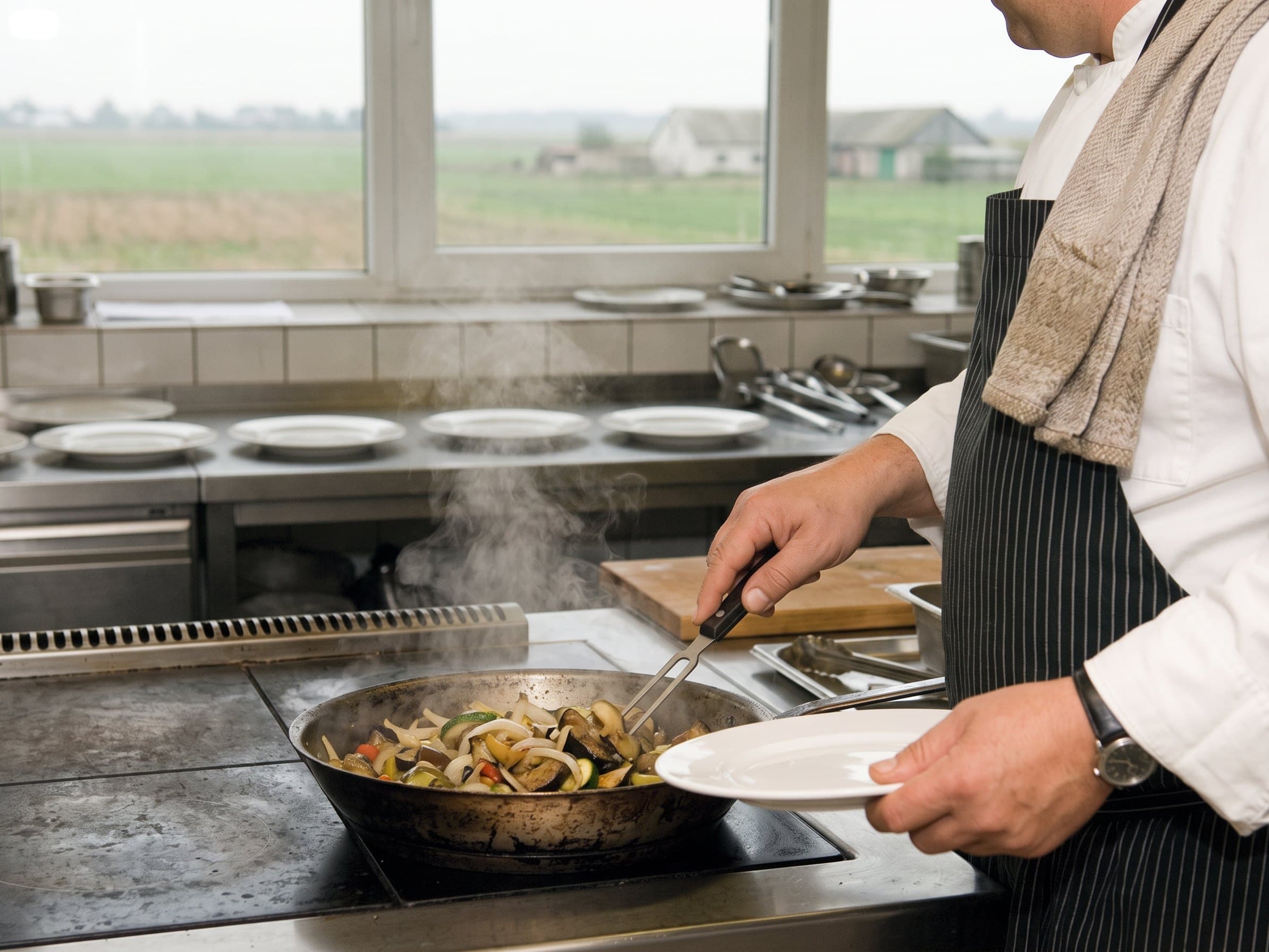
In a restaurant, canteen or catering kitchen, 3 kg jars and 5 kg pails are used over several services, often by several people. A simple routine keeps that under control:
- Label on opening. Product, date and time of opening, the discard date from your HACCP plan and the batch code from the original label, so that traceability is not lost.
- Decant large formats. Transfer a 3 kg jar of pickled gherkins or a 5 kg pail into smaller lidded, food-grade containers, each with its own brine or a smoothed surface, so the bulk is not opened at every service.
- Keep the working portion small. Bring to the pass only what a service needs; afterwards, chill it or discard it, never pour it back into the main container.
- One utensil per container. Dedicated ladles or tongs prevent carry-over between products, including allergens such as the wheat flour in our ikra.
- Never top up. Do not add product from a new jar to an old one; mixing batches muddles both discard dates and traceability.
- Rotate unopened stock by date. The jar with the nearest date goes to the kitchen first.
Paste from a pail keeps better between uses if the surface is smoothed and covered with a thin film of oil or cling film. Our guide to glass jars and pails compares the formats in more detail.
A practical summary for buyers
Unopened MADESA preserves keep for two or three years at 0 °C to +25 °C and no more than 75 % humidity, while the seal is intact. A jar that bulges, leaks, fizzes or smells wrong is discarded, whatever the date. After opening: fridge, clean utensil, a few days and a labelled discard date.
For distributors and retail chains, the minimum remaining shelf life at delivery is agreed in the supply contract, and our product specifications state the shelf life and storage conditions for every item. If you are planning stock for a food service operation or a shelf, request a quote and we will send the documents for the products you need.
Frequently asked questions
Can you eat jarred vegetables after the best-before date?
Generally yes, provided the jar has been stored as the label says and the seal is intact: a best-before date marks the end of guaranteed quality, not of safety. Colour, texture and flavour may have started to change. Any warning sign, such as a raised lid or an off smell, overrides the date.
Do unopened jars of preserves need to be refrigerated?
No. Sterilised jars are shelf-stable and belong in a dry store at 0 °C to +25 °C. Keeping them in a cold room does no harm as long as they do not freeze, but it takes up chilled space that opened products need more.
How long does an opened jar of pickles keep in the fridge?
A few days is the general rule for our products after opening. Pickles that stay under their brine and are served with clean utensils keep better than exposed vegetables. In a professional kitchen, the exact limit comes from the HACCP plan and is written on the container.
What does a bulging lid on a jar mean?
It means the vacuum has been lost or gas has formed inside, a defect known as bombage. Do not open or taste the product; dispose of the jar. A properly sealed jar has a concave lid whose safety button stays down until you open it.
Can a jar that froze in transport still be used?
Check it carefully first. If the glass is cracked, the lid lifted or the vacuum lost, discard it. If the seal is intact, the contents have not been exposed, but quality may suffer: pickles soften and sauces can separate. Report frozen deliveries to the supplier.
Why do some preserves keep for three years and others for two?
For sterilised products, shelf life reflects how long each recipe keeps its colour, texture and flavour, and that differs between, say, a tomato sauce and a jar of pickles. Each MADESA product page states its own figure, which matches the label.