

In short
- HACCP is the Codex Alimentarius method for food safety: analyse hazards, set critical control points and limits, monitor, correct, verify and keep records.
- In vegetable canning, the heat treatment and the integrity of the closure are critical control points in almost every plan; for acidified products, pH is one too.
- Raw material intake, washing, filling, cooling and labelling are also controlled, either as critical control points or through prerequisite programmes.
- ISO 22000 incorporates the HACCP principles; MADESA's ISO 22000 certificate FSMS.8O140.35-2024 is valid until 23 September 2027 and covers both production sites.
- A buyer should ask for the product's critical control points, limits, batch process records, closure checks and traceability, not only for a certificate.
On this page
HACCP in a vegetable preserves plant comes down to a short list of steps where a mistake could make the food unsafe and where nothing later in the process would catch it. In almost every canning plan, the heat treatment and the integrity of the closure are critical control points; for acidified products such as pickles, acidity is critical as well. Raw material intake, washing, filling, cooling and labelling are controlled too, but whether each of them is a critical control point or part of the prerequisite programmes is decided by the plant's own hazard analysis, not by a standard list.
Below, the steps follow the order in which a jar meets them, ending with the questions a buyer can put to a supplier. This is the general industry framework, not a copy of any one company's HACCP plan.
HACCP in brief: the seven principles
HACCP, hazard analysis and critical control points, is the preventive food safety method described by the Codex Alimentarius in its General Principles of Food Hygiene (CXC 1-1969). Rather than relying on tests of finished jars, it controls the points where things can go wrong while production is running. The seven principles are:
- Conduct a hazard analysis and identify control measures.
- Determine the critical control points (CCPs).
- Establish validated critical limits for each CCP.
- Establish a system to monitor each CCP.
- Establish corrective actions for when a limit is not met.
- Validate the plan and establish verification procedures.
- Establish documentation and record keeping.
Five preliminary steps come first, from assembling the HACCP team to drawing the flow diagram and checking it on the factory floor. In the EU, Regulation (EC) No 852/2004 requires food business operators to have procedures based on these principles; Ukrainian food safety law sets the same obligation for producers in Ukraine.
Which hazards matter in canned vegetables
In vegetable preserves, the typical hazards are:
- Biological: spore-forming bacteria, above all Clostridium botulinum in low-acid products, and spoilage organisms that survive a weak heat process or enter through a leaking seal.
- Chemical: residues of pesticides and cleaning agents, and allergens carried in by ingredients such as spice blends.
- Physical: stones from the field, metal from cutting equipment and glass fragments on a jar line.
The most important single fact in the analysis is the pH of the finished product. Foods with a pH above 4.6 are classed as low-acid, and their heat process has to be designed against botulinum spores, which in practice means processing under pressure well above 100 °C. Tomato products, vinegar pickles and jams sit at or below that line and are processed at around 100 °C.
The typical control points, step by step
ISO 22000 distinguishes three levels of control: prerequisite programmes (PRPs), the general hygiene conditions of a plant; operational prerequisite programmes (OPRPs), targeted measures for a significant hazard, monitored against an action criterion; and CCPs, monitored against a measurable critical limit. The table follows a typical line for vegetables in glass; the last column shows the usual classification, which may differ in your supplier's plan.
| Step | Main hazard | Typical control | Usual status |
|---|---|---|---|
| Raw material intake | Residues, spoiled produce, foreign matter, allergens in ingredients | Approved suppliers, specifications, inspection and lot records | PRP; CCP only for a specific hazard |
| Washing and sorting | Soil, stones, insects, high microbial load | Potable water, water changes, sorting belt, stone traps | PRP or OPRP |
| Filling | Fill temperature, headspace or weight outside the process schedule; glass breakage | Checks at set intervals; glass breakage procedure | Critical factor of the heat process; OPRP |
| Closing | Leaking or badly seated closures | Vacuum and closure checks; seam teardown for cans | CCP |
| Heat treatment | Survival of spores and pathogens | Validated time and temperature, continuous recording | CCP |
| Acidification | pH too high for the chosen process | pH of finished product, every batch | CCP |
| Cooling | Contamination from cooling water; slow cooling | Treated cooling water, cooling to a target | OPRP, sometimes CCP |
| Labelling and coding | Undeclared allergens, wrong label, untraceable batch | Label check against specification, code check, line clearance | OPRP, sometimes CCP |
Raw material intake, washing and sorting
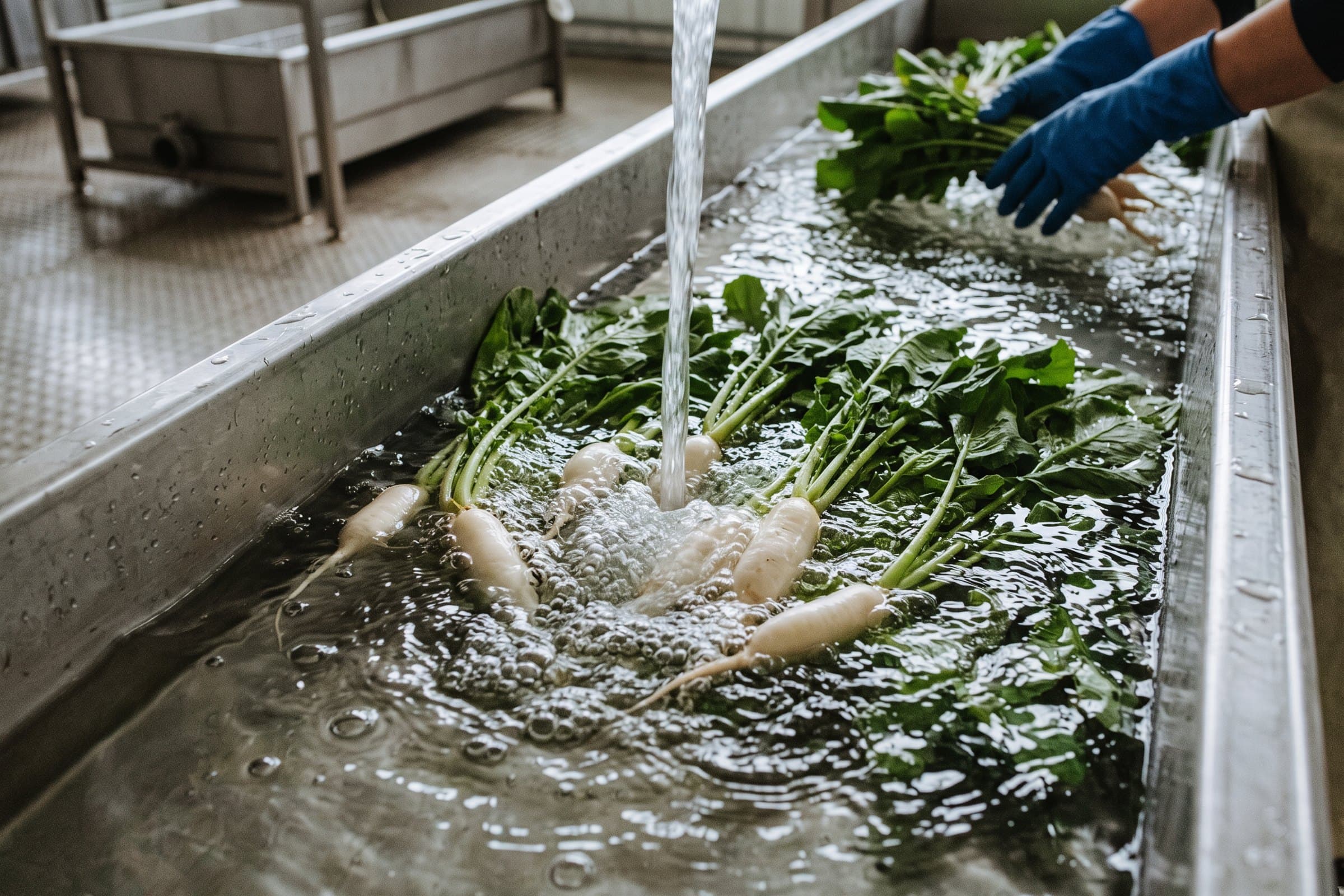
Control starts before the gate, with supplier approval and a specification for each raw material: variety, size, ripeness, permitted defects. At intake, each lot is inspected and recorded with its supplier and date, the first link in traceability. Pesticide residues cannot be seen, so they are managed through supplier agreements and laboratory sampling plans, and a spice blend is a common route for undeclared celery or mustard. Washing in potable water and sorting by hand then remove soil, stones, damaged pieces and much of the microbial load. These steps are usually prerequisite programmes, because the heat process further down the line controls the biological hazard.
Filling: temperature, headspace and weight
A heat process is validated for defined conditions: recipe, piece size, jar size, fill temperature, headspace and fill weight. A jar filled colder or fuller than the schedule assumes heats more slowly at its centre, and the same time and temperature may no longer be enough. Many plans therefore treat these checks as critical factors of the heat-treatment CCP. On a glass line, a glass breakage procedure, stop, clear, inspect, record, belongs to the same step.
Closing and seal integrity
A heat-treated product stays safe only if nothing can enter after processing. For glass jars, checks typically cover the seating of the cap, closure security and the vacuum that forms on cooling, visible on many lids as a concave safety button. For metal cans, the double seam is cut open and measured at set intervals against the can maker's specification. Because no later step would detect a faulty closure, closure integrity is a CCP in most canning plans.
Sterilisation or pasteurisation: time and temperature
The scheduled process, a time at a temperature for a given product and container, is established by heat-penetration studies. Temperature is recorded continuously and time is logged for each load or run; after a deviation the batch is held and evaluated, not released. Glass is usually processed with overpressure in the retort so that lids stay seated while the contents expand. Acid and acidified products are processed at lower temperatures, so their safety depends on the pH; for acidified products such as pickled gherkins, the pH of the finished product is usually a CCP in its own right.
Cooling
Jars are cooled to stop the cooking and protect texture. Two hazards sit here: contamination drawn in through a seal that is still settling, which is why cooling water must be potable and is often treated, and spoilage by heat-loving (thermophilic) bacteria if the product stays warm too long. Glass also needs gradual cooling to avoid thermal shock.
Labelling, coding and traceability
A jar labelled as the wrong product carries the wrong allergen information, and a missing batch code makes a targeted recall impossible. Typical controls are a label check against the approved specification at every changeover, line clearance between products and a legibility check of batch code and date. Traceability links that code back to raw material lots and process records and forward to customers; a recall exercise at planned intervals shows whether the links hold.
What our ISO 22000 certificate covers
ISO 22000 incorporates the HACCP principles, so a current certificate shows that a HACCP-based system exists and has been audited by a third party. Our food safety management system is certified to ISO 22000:2018, adopted in Ukraine as DSTU ISO 22000:2019, under certificate FSMS.8O140.35-2024, valid from 24 September 2024 to 23 September 2027. It was issued by the certification body Ukrsertyfikatsiia, accredited by the National Accreditation Agency of Ukraine (No. 8O140), and continued conformity is verified through scheduled surveillance audits.
The scope covers, among other activities, the manufacture of processed and preserved fruit and vegetables and of sauces, condiments and spices, as well as wholesale trade including warehousing and storage. The certificate names both our production sites, in Chyhyryn and Chornobai, Cherkasy Oblast. It is published on our quality page; how to read such a document is explained in ISO 22000 explained for food buyers.
Questions to ask a supplier about HACCP
A certificate tells you that a system exists. These questions tell you how it works for the product you are buying:
- Which steps are CCPs for this product, and what are the critical limits?
- How was the heat process established, and when was it last revalidated?
- How are time and temperature recorded for each batch, and what happens to a batch after a deviation?
- How often are closures checked, and by which method?
- For acidified products, what is the target pH of the finished product, and how often is it measured?
- Which allergens are handled on site, and how are labels checked at changeover?
- Can a batch code be traced back to raw materials and forward to customers?
- Are samples incubated or otherwise checked before a batch is released?
Expect documents in reply, not adjectives.
For the B2B buyer
Heat process and closure are the critical control points in practically every plan, acidity wherever a product relies on it, and the rest is controlled through prerequisite programmes whose quality shows in the records. Retailers commissioning private label usually run this review during supplier approval. If you are assessing us as a supplier, send us your questionnaire with the products you are interested in, and we will reply with the relevant documentation.
Frequently asked questions
Is HACCP a certificate a supplier can hold?
HACCP itself is a set of principles, not a certificate. A supplier can show that its HACCP-based system has been audited by holding a certificate against a standard that incorporates those principles, such as ISO 22000. That is why MADESA refers to its ISO 22000 certificate rather than making a separate HACCP claim.
Who validates the heat process for canned vegetables?
The manufacturer is responsible, usually working with thermal process specialists who run heat-penetration and temperature-distribution studies in the actual equipment. A process is validated for one product, recipe and container size. It should be revalidated whenever one of them, or the equipment, changes.
Does a pasteurised product have different critical control points from a sterilised one?
The logic is the same: the heat step and the closure remain critical. The limits are lower, so other hurdles such as acidity, chilled storage after opening or a declared additive become part of the control. Our 5 kg tomato paste for food service, for example, is pasteurised and contains ascorbic acid, which is declared on the label.
How often should a HACCP plan be reviewed?
At planned intervals, which many companies set at least once a year, and in addition whenever something relevant changes: a new raw material or supplier, a recipe, a jar size, equipment, or new information about a hazard. A complaint or a deviation that reveals a gap should also trigger a review.
What records should a supplier be able to show for one batch?
Typically the raw material lots used, the heat-treatment record with time and temperature, closure checks, pH results for acidified products, the label check at changeover and the release decision. All of them should be linked by the batch code printed on the jar. A supplier with a working system can retrieve this file quickly.