





In short
- Tomato juice with salt is made from ripe tomatoes that are crushed, sieved, lightly salted and sterilised in a sealed jar, so it keeps without preservatives.
- MIRASA Tomato Juice with Salt has two ingredients, juice of fresh tomatoes and salt, a pulp content of 14–20% and a three-year shelf life at 0 °C to +25 °C.
- The salt in tomato juice is there for taste: it rounds off acidity and brings out sweetness, while heat treatment and the hermetic seal do the preserving.
- Once opened, tomato juice belongs in the fridge in a covered container and should be used within a few days; settling of the pulp is natural, so stir before serving.
- A 3 kg jar holds just under three litres of juice: about a dozen portions of gazpacho or around 14 breakfast glasses of 200 ml.
On this page
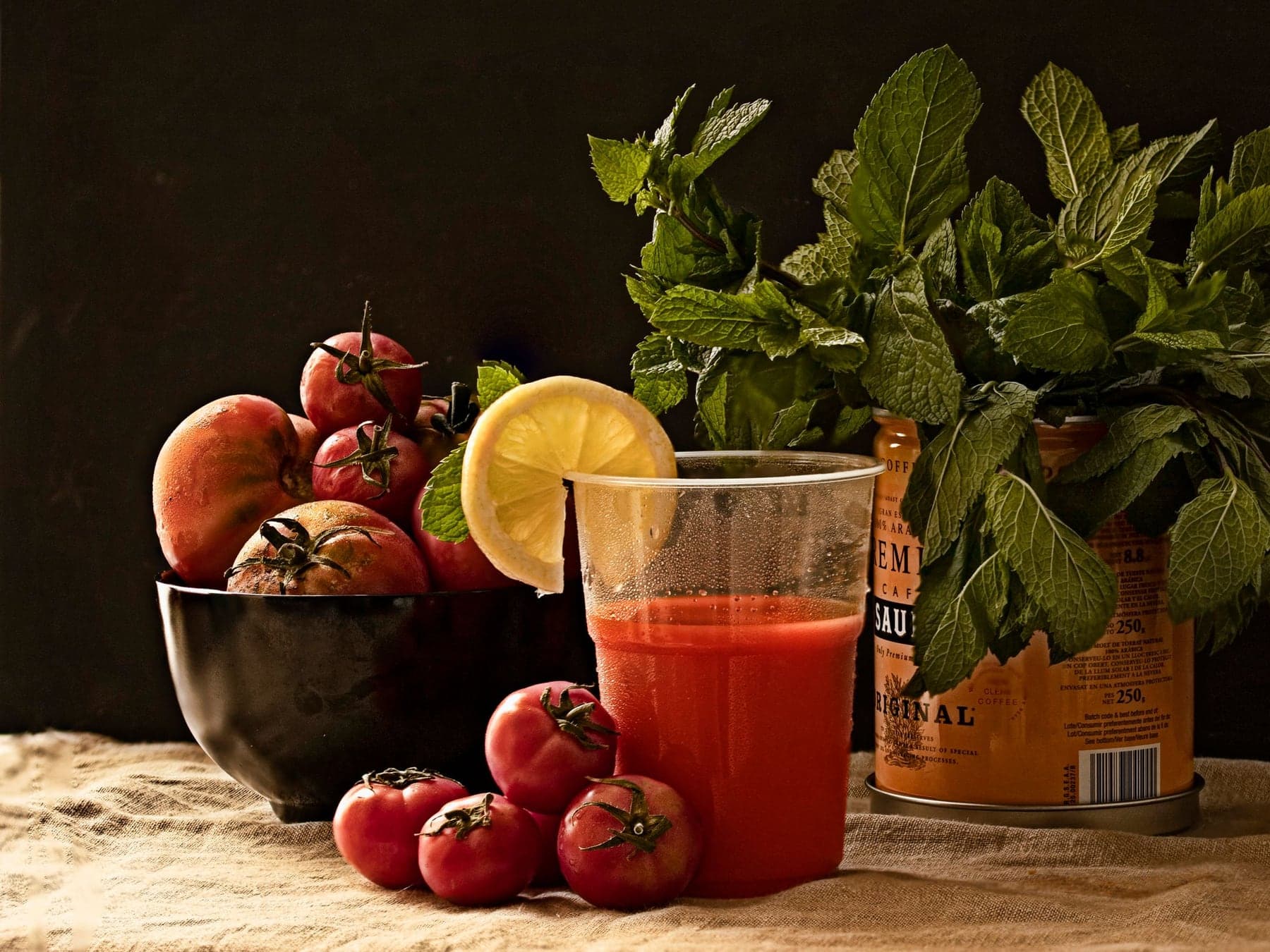
Tomato juice with salt is made from ripe tomatoes that are crushed, sieved free of skins and seeds, lightly salted and sterilised in a sealed jar, so it keeps on the shelf without preservatives until it is opened. The pulp gives it body, the salt rounds off the acidity, and it can go straight into a glass, a blender or a pan. This guide covers how it is made, what the salt does, how to use it and how to store an opened 3 kg jar.
What is in a jar of MIRASA tomato juice
Our Tomato Juice with Salt is sold under the MIRASA brand and made at our site in Chyhyryn, Cherkasy Oblast. The ingredient list has two entries: juice of fresh tomatoes, and salt. There is no added sugar, no thickener, no acidity regulator and no preservative. Colour, body and flavour all come from the tomatoes.
| Parameter | MIRASA Tomato Juice with Salt |
|---|---|
| Ingredients | juice of fresh tomatoes, salt |
| Standard | DSTU 8895:2019 |
| Grade | First grade |
| Pulp content | 14–20% |
| Preservatives | none added |
| Pack | 3 kg glass jar |
| Shelf life | 3 years |
| Storage before opening | 0 °C to +25 °C, relative humidity not exceeding 75% |
DSTU 8895:2019 is a Ukrainian national standard; the juice is made and checked against its parameters, and the label declares first grade under it. The pulp content of 14–20% tells you that this is a juice with pulp, fine particles of tomato flesh suspended in tomato liquid, not a clear drink. The pulp is what makes the juice taste full and what lets it thicken a soup or a sauce without any starch.
How tomato juice is made
The steps below describe the general industrial route for juice made from fresh tomatoes. Equipment and settings vary from plant to plant; the sequence does not.
- Sorting and washing. Ripe, sound tomatoes are washed and inspected. Green, split or mouldy fruit is removed, because a few poor tomatoes can flatten the taste of a whole batch.
- Crushing. The tomatoes are chopped into a coarse mass.
- Heating straight after crushing. Once a tomato is cut, its own enzymes start breaking down pectin, the substance that gives the juice its body. Heating the crushed mass quickly stops them. Processors call this a "hot break"; it helps the juice keep its body instead of thinning out and separating soon after it is made.
- Sieving. The hot mass is pressed through fine screens that hold back skins, seeds and fibrous parts. What passes through is juice with pulp.
- Salting. Salt is added and dissolved evenly through the batch.
- Filling and sealing. The juice is brought back to temperature, filled hot into clean glass jars and sealed.
- Sterilisation and cooling. The sealed jars are heat-treated and cooled. From here on, the heat treatment and the hermetic seal keep the juice safe at room temperature, and no preservative is needed. Our article on sterilisation without preservatives explains the principle in more detail.
Tomatoes have one technical peculiarity: their natural acidity sits close to the pH 4.6 line that canning rules use to separate acid foods from low-acid ones. The heat treatment for tomato products is therefore set with care and documented in the manufacturer's HACCP plan; ours is part of a food safety management system certified to ISO 22000:2018. For the buyer, the practical rule is simple: a sealed, intact jar is shelf-stable, and an opened one is a fresh food.
What the salt does
Salt in tomato juice is a seasoning, not a preservative. At the level that suits a juice meant for drinking it does not stop microbial growth; heat and the seal do that. Its role is taste:
- it softens the sharp edge of tomato acidity, so the juice tastes rounder;
- it brings forward the sweetness and savoury depth of ripe tomatoes;
- it makes the juice ready to drink without anything added at the table.
In Ukraine, tomato juice has long been drunk salted. Many still remember the juice counters of old grocery shops, where a glass of salt with a spoon stood beside the tomato juice. A juice salted at production does that step for you, evenly and the same way in every jar.
Two practical consequences follow. In cooking, season at the end rather than at the start, because the juice already brings its salt with it. And if salt content matters for your menu labelling or for a particular diet, take the figure from the product specification, which we supply on request, rather than estimating it.
How to use tomato juice with salt
Breakfast and the hotel buffet
A glass of chilled tomato juice is a fixture of the Eastern European breakfast and of many hotel buffets. Stir the jug before pouring, and put freshly ground black pepper and lemon wedges alongside. Some guests like a few drops of hot sauce.
The bar
Tomato juice is the base of the Bloody Mary, of its alcohol-free version, the Virgin Mary, and of a whole family of savoury long drinks. A pre-salted juice keeps the seasoning consistent across a shift; the bartender adds lemon, Worcestershire sauce, pepper and horseradish to taste. Because the juice carries real pulp, the drink has body without any thickener.
Gazpacho and other cold soups
Cold soups are where a good tomato juice saves the most work. Instead of blanching, peeling and sieving fresh tomatoes, you blend the juice with cucumber, sweet pepper, onion, garlic, a little bread and olive oil, then chill. Our quick gazpacho takes one litre of juice for four portions and about twenty minutes of work. Taste it before you reach for the salt.
Soups, sauces and braises
In the kitchen, treat tomato juice as a liquid, not a concentrate:
- part of the liquid in tomato soup, bean soup or a vegetable soup;
- a braising liquid for cabbage rolls, stuffed peppers or meatballs, giving a lighter, fresher sauce than diluted paste;
- the cooking liquid for rice or bulgur;
- a quick pan sauce: reduce by about a third with garlic and herbs, then finish with a little butter or oil.
Juice, passata or paste?
| Product | What it is | Typical use |
|---|---|---|
| Tomato juice | sieved juice with pulp, ready to drink | drinks, cold soups, braising, cooking grains |
| Passata | sieved tomato purée, thicker than juice | pasta sauces, pizza, soups |
| Tomato paste | tomatoes concentrated by evaporation | colour and depth in borscht, stews and sauces |
Tomato paste diluted with water gives colour and tomato flavour, but it tastes cooked down; juice keeps a fresher character.
Storing tomato juice after opening
Unopened, the jar keeps for three years at 0 °C to +25 °C. Once the seal is broken, the juice needs the same care as any fresh food:
- Refrigerate straight after opening, at the temperature your HACCP plan sets for chilled foods.
- Decant a 3 kg jar into clean, lidded jugs or food-grade containers if it will be used over more than one service.
- Use within a few days. The label and your own HACCP plan set the exact limit.
- Pour, never dip. Use a clean jug or ladle every time.
- Stir or shake before serving. Some settling of the pulp over time is natural for a juice without thickeners and is not a fault.
- Freeze leftovers for cooking, in portions. Thawed juice separates and is best used in soups and sauces.
Before opening, look at the jar. A domed lid, a seal that has lifted, foam or a fermented smell are reasons to discard the jar without tasting it.
The 3 kg jar in food service
A 3 kg jar holds just under three litres of juice. For a kitchen or bar that pours tomato juice every day it is the practical format: sterilised, so it waits in dry storage rather than in the cold room; glass, so the product is visible; and one jar to open, empty and recycle instead of a row of small packs. As a rough guide, one jar gives:
- about 14 breakfast glasses of 200 ml;
- about a dozen portions of gazpacho;
- two dozen or more savoury long drinks, depending on the recipe.
That arithmetic only works if the open jar is used up in time: a hotel breakfast with steady demand finishes a jar in a service or two, while a bar pouring a few drinks an evening should decant the juice into smaller containers on opening.
For B2B buyers: a practical summary
- Two ingredients, juice of fresh tomatoes and salt, with no added preservatives.
- First grade under DSTU 8895:2019, pulp content 14–20%.
- 3 kg glass jar, three-year shelf life, ambient storage before opening.
- Settling of the pulp is natural; train staff to stir before pouring.
- One product covers breakfast, bar and kitchen, which makes it a straightforward line for hotels, caterers and restaurants; our food service page describes how we work with professional kitchens.
For samples, the product specification or case and pallet configurations, send a request through the quote form.
Frequently asked questions
Is tomato juice with salt made from concentrate?
Not in our case. Juice from concentrate is made by diluting tomato paste or concentrate with water, while MIRASA Tomato Juice with Salt lists juice of fresh tomatoes and salt as its only ingredients. Its pulp content is 14–20%.
Why does tomato juice separate after standing?
The pulp slowly settles out of the tomato liquid, which happens in any juice with pulp that contains no thickener or stabiliser. It is not a sign of spoilage. Stir the jug, or shake a smaller container, before pouring and the juice is even again.
Does unopened tomato juice need to be refrigerated?
No. A sealed, sterilised jar keeps for its full three-year shelf life at 0 °C to +25 °C. Chilling before service is a matter of taste; after opening, refrigeration is required.
How much tomato juice goes into a Bloody Mary?
Classic recipes use about twice as much tomato juice as vodka, typically around 90 ml of juice per drink, plus lemon juice and seasoning. On that basis a 3 kg jar covers roughly 30 drinks.
Can you cook with salted tomato juice?
Yes. It works as the liquid in soups, braises and grain dishes and as the base of a quick pan sauce. As it is already salted, taste the dish and add any extra salt only at the end.