

In short
- Jarred marinated button mushrooms are cultivated champignons that are trimmed, blanched, packed in a spiced vinegar marinade and sterilised, so they are ready to eat from the jar.
- A marinade is acidified with vinegar and seasoned with sugar and spices; a brine is mainly salted water and gives a neutral mushroom for cooking.
- MIRASA Marinated Button Mushrooms contain whole mushrooms at 70.0% with water, acetic acid, sugar, salt, garlic, allspice, black pepper and bay leaf, and no added preservatives.
- Drain marinated mushrooms in a sieve for a few minutes before use; leftovers belong in the fridge, covered by their marinade, in a clean lidded container.
- A 3 kg jar with mushrooms at 70% of the recipe holds roughly 2 kg of mushrooms, enough for several dozen starter or pizza portions.
On this page
Marinated button mushrooms are cultivated champignons that have been trimmed, blanched, packed in a spiced vinegar marinade and sterilised in a sealed jar. They are a ready-to-eat product: drain them, and they go straight into a salad, onto a pizza or onto a starter plate. This guide covers how they are made, how a marinade differs from a brine, how kitchens use them, and how to drain, store and portion a 3 kg jar.
What is in a jar of MIRASA mushrooms
Our marinated button mushrooms are sold under the MIRASA brand and made at our site in Chyhyryn, Cherkasy Oblast. The mushrooms are packed whole. The rest of the ingredient list will be familiar to anyone who has put up mushrooms at home: vinegar, a little sugar and salt, garlic, allspice, black pepper and bay leaf.
| Parameter | MIRASA Marinated Button Mushrooms |
|---|---|
| Ingredients | whole button mushrooms (70.0%), water, acetic acid, white sugar, salt, garlic, whole allspice, black peppercorns, bay leaf |
| Form | whole, sterilised |
| Standard | TU U 10.3-44851902-001:2023 |
| Grade | First grade |
| Preservatives | none added |
| Pack | 3 kg glass jar |
| Shelf life | 2 years |
| Storage before opening | 0 °C to +25 °C, relative humidity not exceeding 75% |
The figure to note is the 70.0%: mushrooms make up seven tenths of the recipe and the marinade the rest. That ratio is what you are paying for, and we come back to it below when we work out how far a jar goes.
How marinated mushrooms are made
The general industrial route for marinated button mushrooms looks like this. Plants differ in equipment and timings; the logic of the steps is the same.
- Fresh raw material. Button mushrooms (Agaricus bisporus) are cultivated indoors and harvested all year round. Once picked, they darken and lose moisture quickly, so they are processed fresh.
- Trimming and sorting. Stems are trimmed, traces of the casing soil are removed and the mushrooms are graded by size, so that a jar of whole mushrooms looks even and heats evenly.
- Washing. Several rinses remove the remaining particles.
- Blanching. The mushrooms are heated briefly in water or steam. This drives air and part of the water out of the tissue, shrinks the mushrooms before they go into the jar and stops the enzymes that turn cut mushrooms brown. Unblanched mushrooms would keep shrinking after sealing and leave a jar that looks half empty.
- Filling. The mushrooms go into jars with garlic, allspice, peppercorns and bay leaf and are covered with a hot marinade of water, vinegar, sugar and salt.
- Sealing and sterilisation. The jars are sealed, sterilised and cooled. Heat treatment and the hermetic seal, together with the acidity of the marinade, keep the product safe without preservatives until it is opened.
Mushrooms are a low-acid food by nature. In a marinade, the vinegar raises the acidity of everything in the jar, and the balance of acidity and heat treatment is fixed in the product specification and controlled under the manufacturer's HACCP plan. Ours sits within a food safety management system certified to ISO 22000:2018.
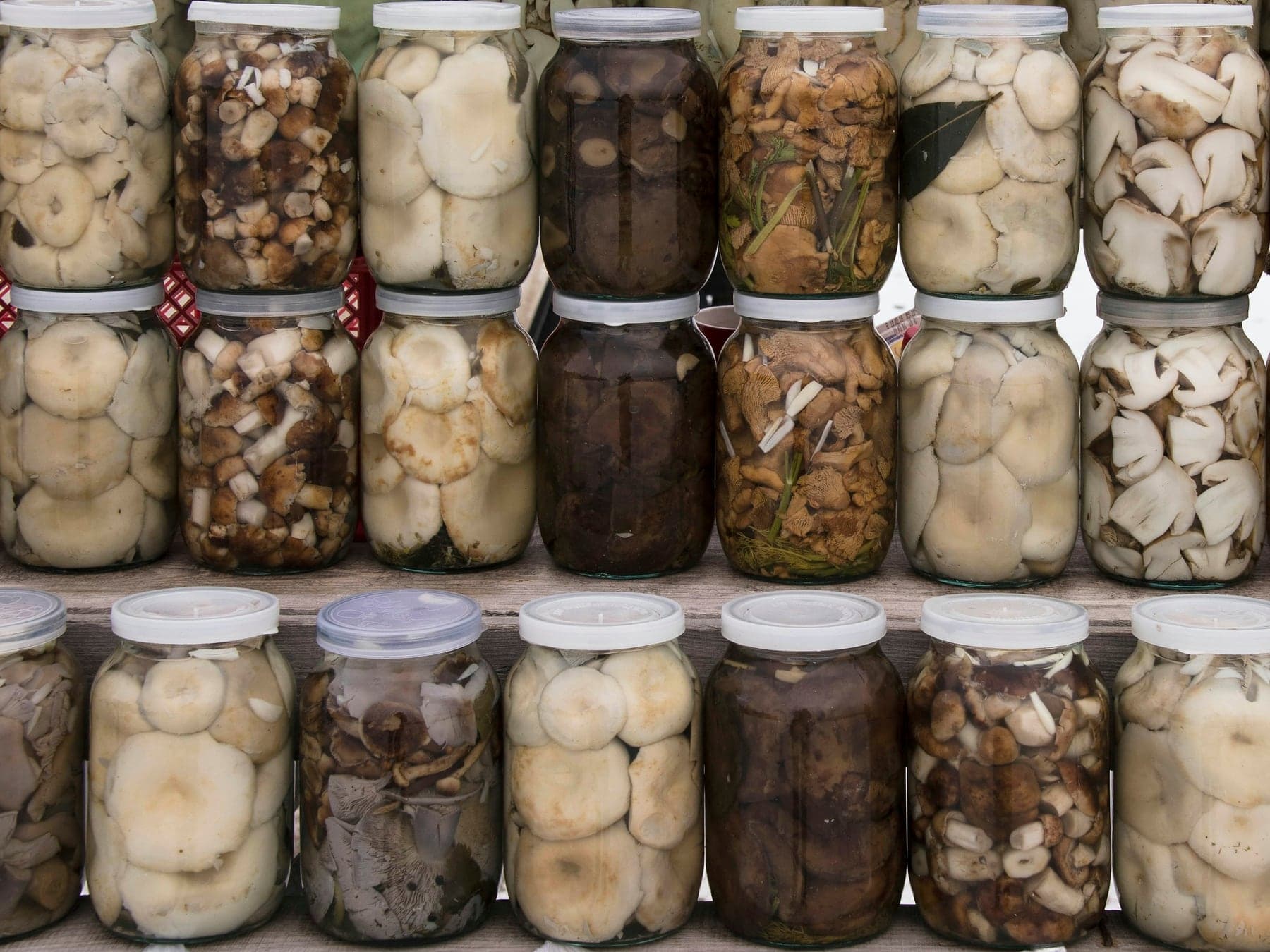
Marinade, brine or salted: what is the difference?
Three words are used for mushrooms preserved in a jar, and they describe three different products.
| Marinated | In brine | Salted (fermented) | |
|---|---|---|---|
| Liquid | water, vinegar, sugar, salt, spices | water and salt, often with an acidity regulator | salt and the mushrooms' own juices; acidity develops through fermentation |
| Taste | tangy, lightly sweet, spiced | neutral, mildly salty | sour, deep, salty |
| Typical mushrooms | button mushrooms, also wild species | button mushrooms | traditionally wild species such as milk caps |
| Main use | eaten cold: salads, starters, zakuska | cooking: sauces, pizza, stews | cold starter in traditional cuisine |
Our mushrooms are marinated, and that matters for the menu. A marinated mushroom brings acidity and spice with it: welcome on a starter plate or in a salad, less so in a delicate cream sauce. If a recipe was written for mushrooms in brine, rinse the marinated ones briefly under cold water and pat them dry; the spice notes stay and the sharpness softens. The same line between a vinegar marinade and natural fermentation runs through cucumbers, and we explain it in Pickled or fermented?
How to use marinated mushrooms
Salads
The simplest Ukrainian starter is a bowl of drained mushrooms with thinly sliced onion, dill or spring onion and a spoonful of unrefined sunflower oil. Nothing else is needed. The mushrooms also work in potato salads, chicken salads and layered festive salads, where their acidity balances a mayonnaise dressing.
Pizza and hot dishes
For pizza, slice the mushrooms and pat them dry, otherwise the marinade will wet the base. They pair well with ham, salami, onion and mozzarella, and because they are already cooked they only need to heat through. In hot dishes, add them at the end: to potatoes fried with onion, to buckwheat, to a pan of braised chicken. Rinse them first if the dish contains cream.
Deruny
Hot, crisp potato pancakes and cold, tangy mushrooms are a classic Ukrainian pairing. Our deruny with marinated mushrooms recipe tosses 300 g of drained mushrooms with red onion, unrefined sunflower oil and dill and serves them with soured cream beside the pancakes. On a restaurant menu the dish works as a starter or as a vegetarian main course.
The zakuska plate
On a zakuska plate, the cold starters served with bread at a Ukrainian table, marinated mushrooms sit next to pickled cucumbers, tomatoes and courgettes, salo, smoked sausage and rye bread. Serve them in a small bowl rather than directly on a wooden board, because marinade stains wood.
In food service
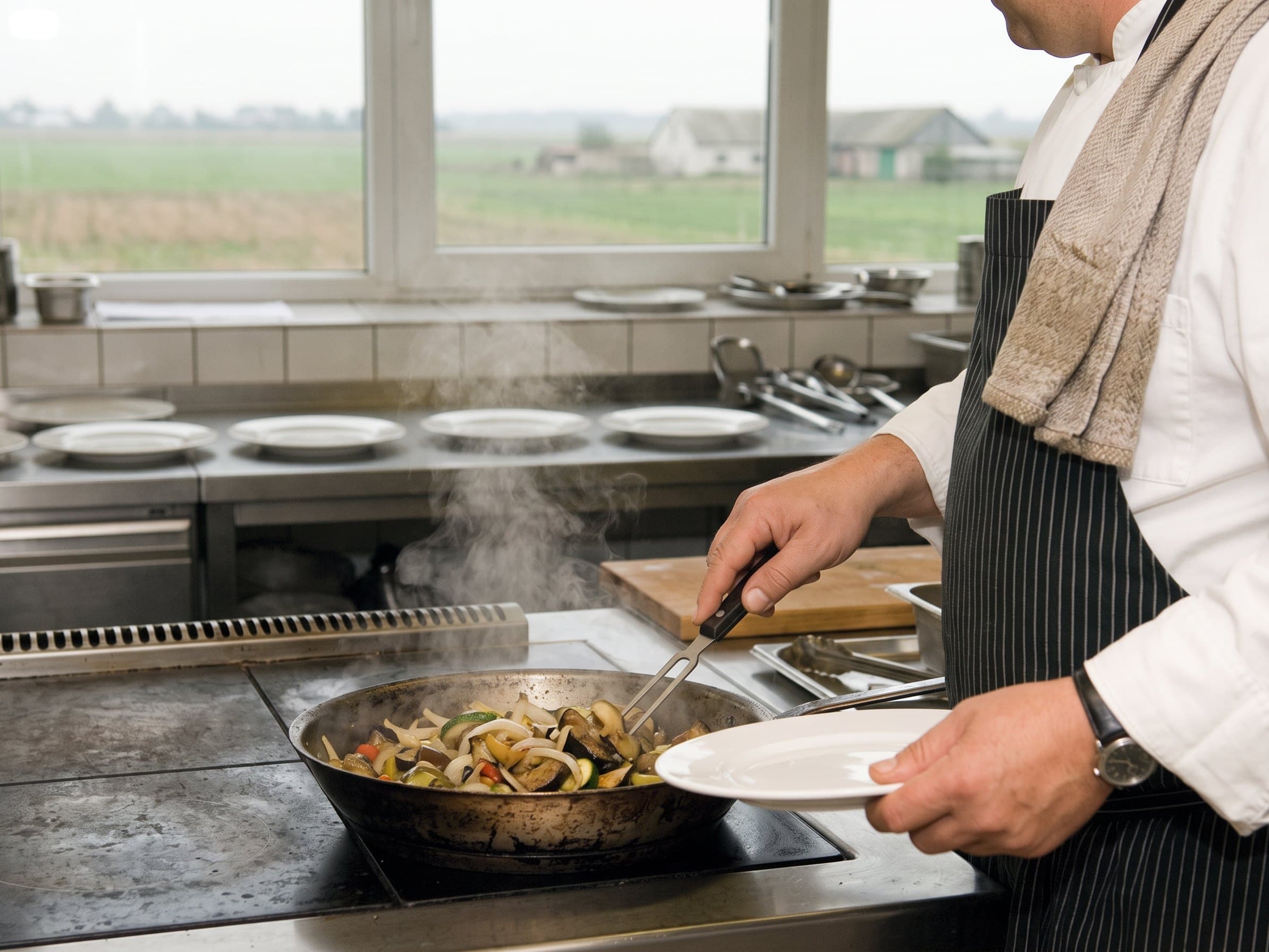
For a professional kitchen the jar is a ready component: no cleaning, no cooking and no trimming waste. Pizza stations, salad bars, banquet starters, staff canteens and hotel buffets can use the mushrooms exactly as they come out of the jar, which keeps preparation time and portion cost predictable.
Draining and storing
- Drain before use. Tip the mushrooms into a sieve for three to five minutes; for pizza and hot dishes, pat them dry with kitchen paper.
- Adjust the taste if needed. A brief rinse under cold water gives a milder mushroom.
- Keep the marinade. Until the jar is finished, leftover mushrooms keep best covered by their own liquid.
- Refrigerate after opening. Keep the mushrooms under the marinade in a clean, lidded container and use a clean utensil every time.
- Divide large jars. If a 3 kg jar will last more than one service, split it into smaller containers on the day you open it.
- Use within a few days. The label and your own HACCP plan set the exact limit.
- Do not reuse the marinade for raw vegetables or for a new batch of mushrooms.
Check the jar before opening. A domed lid, a seal that has lifted, rising gas bubbles, foam or an off smell are reasons to discard it without tasting.
How far does a 3 kg jar go?
The ingredient list declares mushrooms at 70.0% of the recipe. In a 3 kg jar that means roughly 2 kg of mushrooms at filling; the rest is marinade. The drained weight, the figure that matters for portion costing, can differ somewhat from the recipe share, because mushrooms and marinade exchange liquid during heat treatment and storage. If you cost to the gram, ask for the specification. As a working estimate based on about 2 kg of drained mushrooms:
| Use | Typical portion of drained mushrooms | Approximate portions per 3 kg jar |
|---|---|---|
| Starter or zakuska plate | 60–80 g | 25–33 |
| Pizza topping | 50–70 g | 28–40 |
| Deruny with mushroom salad (our recipe) | about 75 g | about 26 |
| Salad component | 30–50 g | 40–65 |
Compared with fresh mushrooms, the yield is easy to plan: there is no trimming loss, no shrinkage in the pan and no spoilage in the cold room before use.
For B2B buyers: a practical summary
- Whole button mushrooms in a spiced vinegar marinade, sterilised, with no added preservatives.
- First grade, TU U 10.3-44851902-001:2023; two-year shelf life; ambient storage before opening.
- 3 kg glass jar, with mushrooms at 70.0% of the recipe.
- Ready to eat: drain, then serve cold or add at the end of cooking.
- A fit for pizza, salad and starter stations; our food service page describes how we supply professional kitchens.
For samples, the specification and case and pallet configurations, use the quote form.
Frequently asked questions
Are marinated mushrooms already cooked?
Yes. The mushrooms are blanched before filling and the sealed jar is sterilised, so they are fully cooked. Serve them cold straight from the jar after draining, or add them at the end of a hot dish just to warm through.
Can marinated mushrooms replace fresh mushrooms?
In many dishes, yes: salads, pizza, cold starters and quick pan dishes. They will not brown like fresh mushrooms and they bring acidity and spice, so for cream sauces rinse them first and add them late. For dishes built on well-browned fresh mushrooms, fresh ones remain the better choice.
Do MIRASA marinated mushrooms contain allergens?
No allergen is declared in the ingredient list: mushrooms, water, acetic acid, sugar, salt, garlic, allspice, black pepper and bay leaf. A formal allergen statement that also covers cross-contact is available per product on request.
Can you freeze marinated mushrooms?
You can, but it is not recommended: after thawing, the mushrooms turn soft and watery. It is better to divide an opened 3 kg jar into smaller containers straight away and plan to use it within a few days.
Are champignons and button mushrooms the same thing?
Yes. Both names refer to the same cultivated species, Agaricus bisporus. Champignon is the usual name in much of continental Europe and in Ukrainian, while button mushroom is the common English name for the young, closed white caps.